

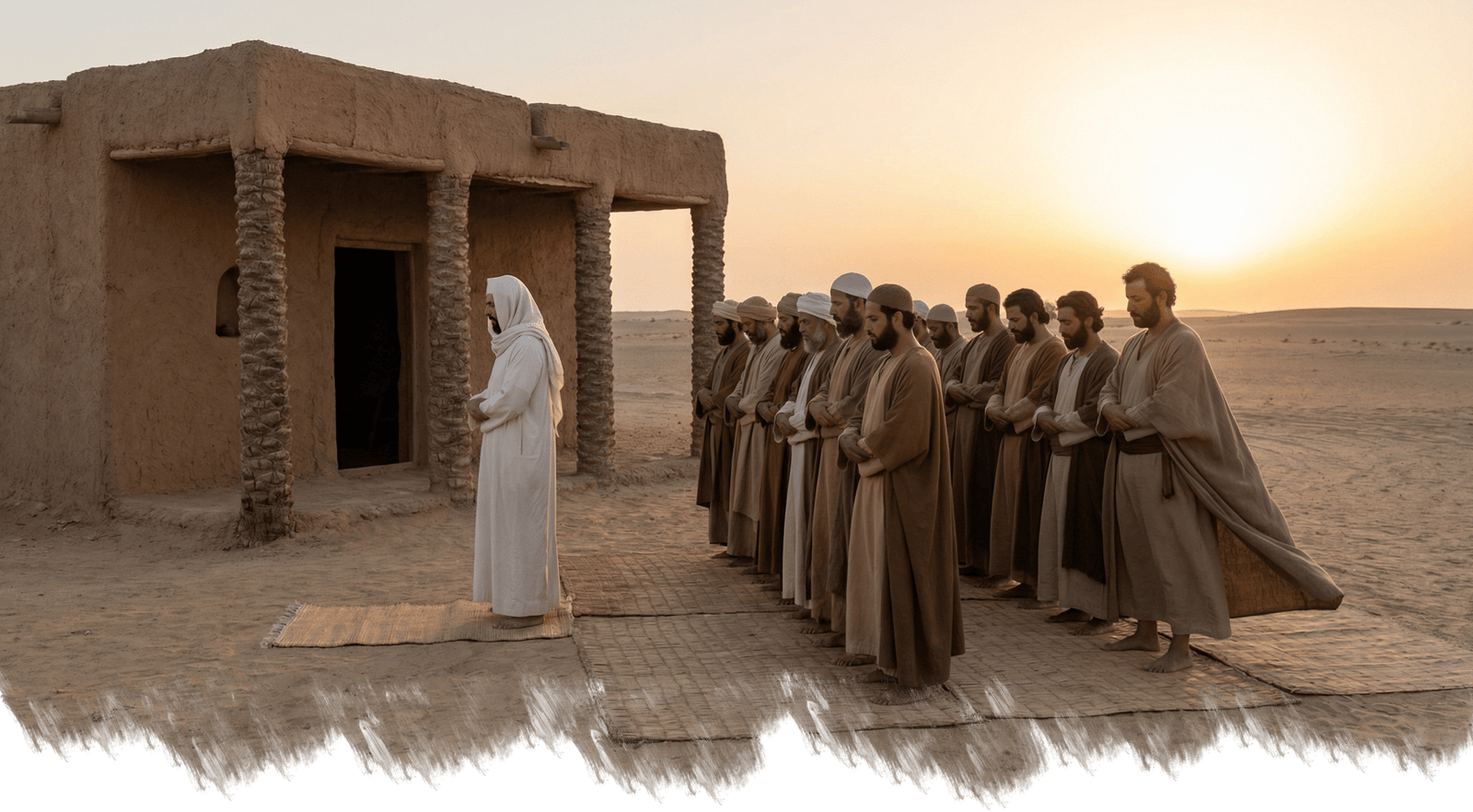
Salah, also known as Salat or Prayer, is one of the five pillars of Islam and is a fundamental act of worship for Muslims. It involves the obligatory act of praying 5 times a day at set times, and is a direct means of communication with Allah.
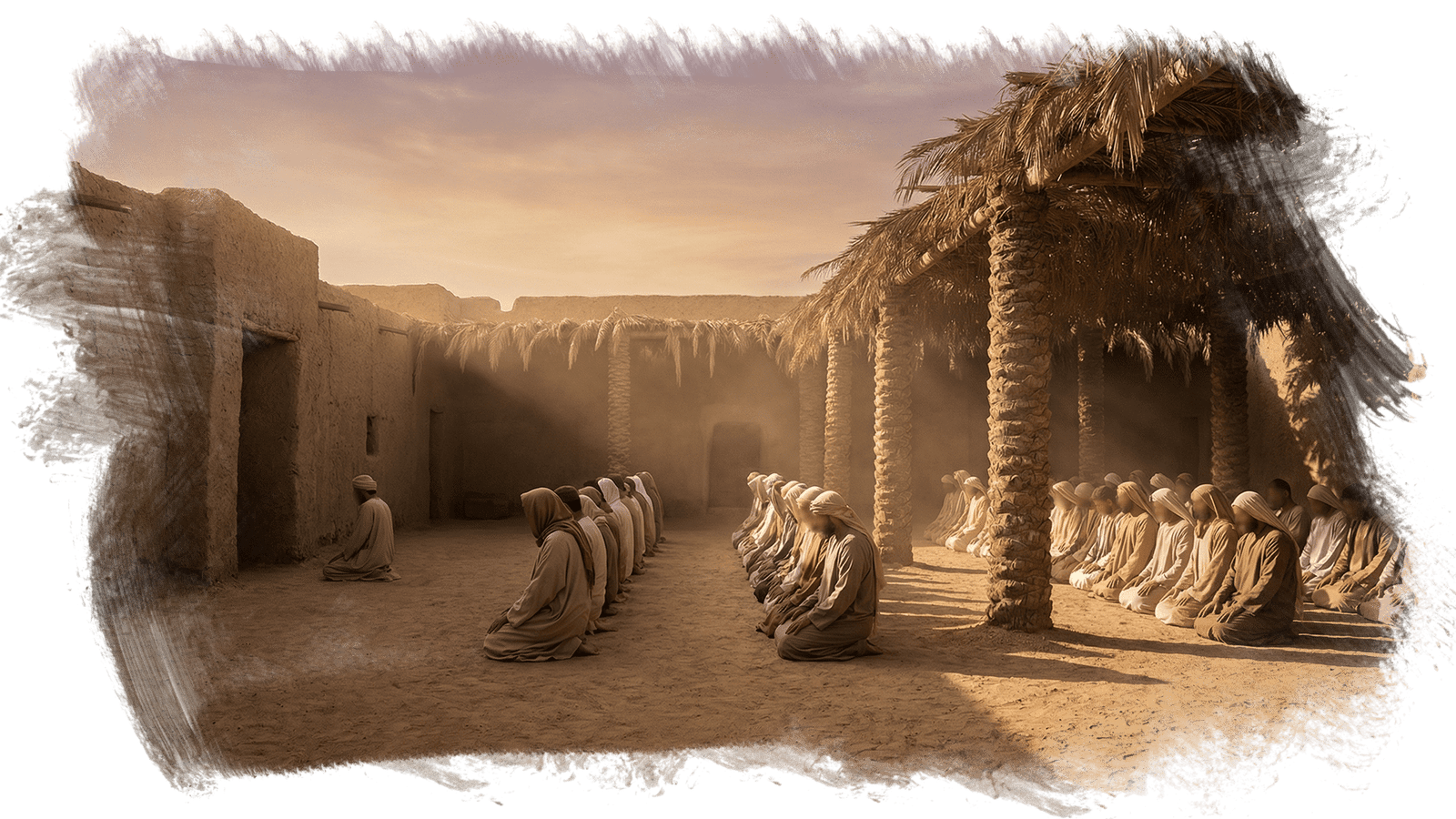
Muslims perform Salah as an essential part of their daily lives to seek guidance, forgiveness, and blessings from Allah and to fulfil their rights to Him. It involves performing specific physical movements and recitations whilst facing the Qiblah (direction of the Ka’bah in Makkah). The key in Salah is to be focused and concentrate on the presence of Allah.
ﲳ ﲴ ﲵ ﲶ ﲷ ﲸ ﲹ ﲺ ﲻ ﲼ ﲽ ﲾ ﲿ ﳀ
Innamaa waliyyukumul laahu wa Rasooluhoo wal lazeena aamanul lazeena yuqeemoonas Salaata wa yu’toonaz Zakaata wa hum raaki’oon
English Translation:
“Your ally is none but Allah and [therefore] His Messenger and those who have believed – those who establish prayer and give zakah, and they bow [in worship].”
— (Surah Al-Ma’idah 5:55)
Muslims must perform 5 daily prayers. These are:
Fajr – this takes place at pre-dawn.
Dhuhr – this takes place just after the sun reaches its zenith.
Asr – this takes place between noon and sunset.
Maghrib – this takes place just after sunset.
Isha – this takes place during the night/at night-time.
Salah is an integral part of the lifestyle of a Muslim. Through prayer, Muslims are required each day to ponder on the verses of the Qur’an, the Shahadah (the declaration of faith), and Allah’s attributes.
Muslims across the world unite in prayer at five specified times each day in the direction of the Ka’bah in Mecca, as a means of connecting to Allah and their purpose in life – to remember and worship Him.
ﱁ ﱂ ﱃ ﱄ ﱅ ﱆ ﱇ ﱈ ﱉ
Haafizoo ‘alas salawaati was Salaatil Wustaa wa qoomoo lillaahi qaaniteen
English Translation:
“Maintain with care the [obligatory] prayers and [in particular] the middle prayer and stand before Allah, devoutly obedient.”
— (Surah Al-Baqarah 2:238)
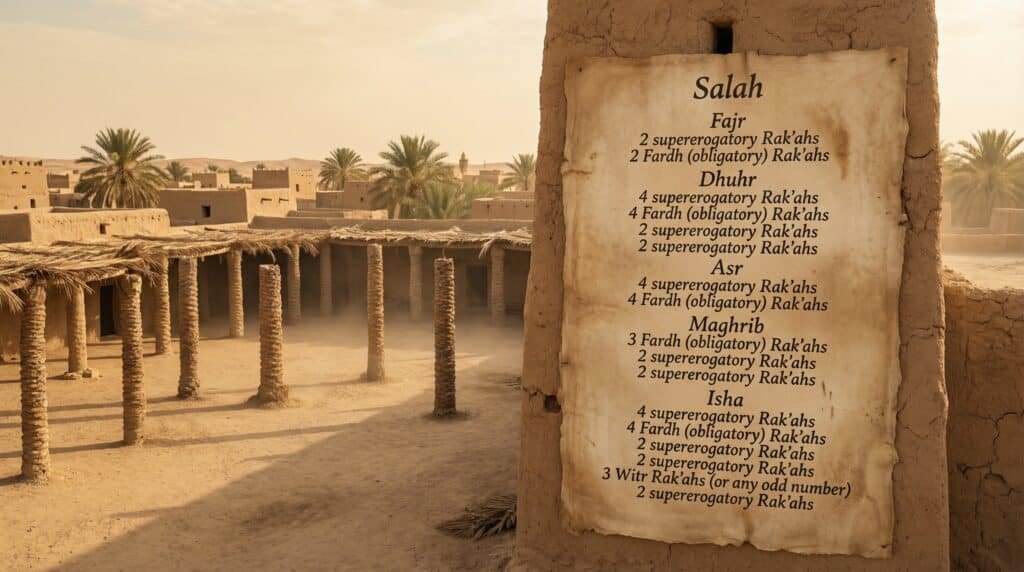
The 5 Salahs consist of various Fardh (obligatory) and supererogatory/recommended aspects. These are as follows:
| Salah | ||||||
|---|---|---|---|---|---|---|
| Fajr | 2 supererogatory Rak’ahs | 2 Fardh (obligatory) Rak’ahs | ||||
| Dhuhr | 4 supererogatory Rak’ahs | 4 Fardh (obligatory) Rak’ahs | 2 supererogatory Rak’ahs | 2 supererogatory Rak’ahs | ||
| Asr | 4 supererogatory Rak’ahs | 4 Fardh (obligatory) Rak’ahs | ||||
| Maghrib | 3 Fardh (obligatory) Rak’ahs | 2 supererogatory Rak’ahs | 2 supererogatory Rak’ahs | |||
| Isha | 4 supererogatory Rak’ahs | 4 Fardh (obligatory) Rak’ahs | 2 supererogatory Rak’ahs | 2 supererogatory Rak’ahs | 3 Witr Rak’ahs (or any odd number) | 2 supererogatory Rak’ahs |
Aside from the five obligatory prayers, Muslims may offer Sunnah and Nafl Salah.
The Sunnah Salah (prayers) are ones in which Prophet Muhammad (peace be upon him) used to habitually offer as voluntary worship at specified times and places.
Nafl Salah are voluntary prayers that a Muslim may offer at any time as a form of extra Ibadah (worship). Optional prayers include Salat al-Istikhara (the prayer of seeking guidance), Salat at-Tahajjud (prayed late at night) or Salat at-Tawbah (prayer for repentance).
Salah is a ritual prayer that requires certain etiquettes in order to perform it correctly. However, there are some slight differences in what etiquettes are required depending on the Madhab (school of thought) you follow within the Fiqh of Islam (Islamic jurisprudence). All four schools of thought are agreed upon and the prayer following any of these is valid.
Eid prayer is prayed in congregation with other Muslims on the mornings of the two Eid celebrations, Eid al-Adha and Eid al-Fitr.
Salah times are appointed to times of the day that depend on the position of the sun. Since parts of the world experience daylight and night differently, it is important to follow the prayer times where you are situated. An authority will usually gather and publish the prayer time in your area for the public’s ease.
Salah (prayer) forms an essential part of our daily lives as Muslims. The importance of Salah is crucial, and is a way for us to communicate with Allah (SWT), through obligatory prayers 5 times a day at set times.
Our purpose in this life is to worship Allah, and Salah provides a means of communication with our Lord.
As the second pillar of Islam, Salah is an important part of the foundation of Deen (religion), coming second to the Shahada (the declaration of faith).
It is one of the most virtuous deeds, as narrated by Ibn Masud – a companion of the Prophet (peace be upon him):
I asked Allah’s Messenger [which deed is most virtuous]. He said: “Salah at the beginning of its time.” I asked him: “What is after that O Messenger of Allah?” He said: “Being dutiful to one’s parents.” I said: “What is after that [O Messenger of Allah]?” He said: “Jihad in the Way of Allah.”
[Hadith | Tirmidhi]
It will also be one of the first things we are questioned on when we enter the grave, as narrated by Abu Huraira, the Prophet (PBUH) said:
The first action for which a servant of Allah will be held accountable on the Day of Resurrection will be his prayers. If they are in order, he will have prospered and succeeded. If they are lacking, he will have failed and lost. If there is something defective in his obligatory prayers, then the Almighty Lord will say: ‘See if My servant has any voluntary prayers that can complete what is insufficient in his obligatory prayers. The rest of his deeds will be judged the same way.’
[Hadith | Tirmidhi]
Salah holds an important place in our lives, and therefore we must try our best to keep it at the forefront of all we do.
As well as fulfilling an obligatory act prescribed upon us, there are several benefits to performing our Salah. These include:
The history of Salah in Islam includes the story of Al Isra Wal Miraj, the miraculous night journey and ascension which took Prophet Muhammad (PBUH) from Makkah to Masjid Al-Aqsa in Jerusalem before ascending to heaven, all in one night around the year 621 CE.
It was on this night that he (PBUH) met with other Prophets and was given the five daily prayers, leading them in prayer.
This journey still shapes our lives today, forming our 5 obligatory daily prayers.
As mentioned, Muslims pray Salah because it is an obligatory act prescribed upon us, and forms one of the fundamental 5 pillars of Islam. We pray Salah to remain close to our Deen (religion) and gain closeness to Allah.
Praying Salah serves as a way to remember Allah, talk to Him, and connect with Him.
Salah (prayers) are a fundamental part of our daily lives as Muslims, and as such, our five daily prayers, consist of a number of different types of Salah which include compulsory and optional Rak’ahs (units of prayer).
The different types of Salah consist of Fardh (obligatory), Sunnah (the regular practice of the prophet) and Nafl (optional) prayers.
Fardh prayers and Rak’ahs (units of prayer) are the prayers which are compulsory for us to perform.
The number of Fardh Rak’ahs differ for each prayer. For our five daily prayers, these are as follows:
Sunnah prayers are extra voluntary prayers that Prophet Muhammad (peace be upon him) would pray in addition to Fardh prayers. Although these are optional, it is highly recommended to follow the Sunnahs of the Prophet (PBUH) to maximise our rewards.
It was narrated that the Prophet (PBUH) said:
Whoever prays 12 Rak’ahs during the night and day, a house will be built for him in Paradise: Four before Zuhr and two after, two Rak’ahs after Maghrib, two Rak’ahs after Isha and two Rak’ahs before Fajr prayer.
[Hadith | Tirmidhi]
Nafl prayers, also known as optional prayers, are additional prayers that Muslims can perform to earn extra rewards and gain nearness to Allah.
Nafl prayers can be offered at any time (as long as it’s not during a forbidden time), and you can pray as many Rak’ahs as you would like by dividing it into two Rak’ahs at a time.
Nafl prayers include Salat al-Istikhara (the prayer of seeking guidance), Salat at-Tahajjud (prayed late at night) or Salat at-Tawbah (prayer for repentance).
Witr prayer is a voluntary night prayer in Islam, usually offered after the Isha prayer, the last of the five daily obligatory prayers.
The word “witr” translates to “odd” or “single” in Arabic, referring to the odd number of rak’ahs (units) performed in this prayer. It holds special significance in the Islamic faith and is highly recommended.
The Witr prayer can be offered as one, three, five, seven, or any odd number of Rak’ahs – with one Rak’ah being the minimum according to the majority of scholars and three Rak’ahs being the minimum in the Hanafi madhab. The most common practice is to perform three Rak’ahs in the Witr prayer. The Witr Prayer is also a Nafl Prayer.
As Muslims, it’s Fardh (obligatory) upon us to perform Salah (prayer) five times a day. This guide takes you through a step-by-step process of how to pray Salah.
It is essential to acknowledge that there may be slight differences of opinion regarding certain movements in the prayer depending on which Madhab (school of thought) you follow. However, the fundamental principles of prayer remain the same.
Salah consists of a set number of Rak’ahs (units of prayer) for each of the five daily prayers. These are divided into Fardh (obligatory) and Sunnah or Nafl (optional) prayers.
The number of Fardh Rak’ahs differ for each prayer. For our five daily prayers, these are as follows:
In addition to the Fardh Rak’ahs, there are Sunnah and Nafl prayers that were regularly observed by the Prophet (PBUH) and carry great reward. The number of these may vary slightly depending on the Madhab followed.
As well as fulfilling an obligation prescribed by Allah, Salah brings many spiritual and personal benefits.
Through prayer, a Muslim can strengthen their connection with Allah, standing before him in focused worship five times a day.
In Surah Al-Ma’arij, Allah says:
Verily, man was created impatient, irritable when evil touches him and niggardly when good touches him. Except for those devoted to prayer, those who remain constant in their prayers…
[Qur’an | Surah Al-Ma-arij | 70:19-23]
When it’s time for Salah, make sure you have performed Whudu (ablution) before the prayer.
Make sure you’re wearing clothing that covers your Awrah (intimate parts) – for men, this is to cover everything from and including the navel to the knees, and for women, this means covering everything except the hands, feet and face.
Find a clean, convenient place to pray.
Here is a step by step guide of how to pray the Fardh Rak’ahs for Salah.
Make a sincere intention for the specific prayer you want to perform, whether it’s Fajr, Dhuhr, Asr, Maghrib, or Isha.
Before beginning your Salah, you need to make Niyyah.
Face the Qibla (the direction of the Ka’aba in Mecca) and stand with feet shoulder-width apart.
You need to face the direction of the Qibla during your Salah.
Raise both hands to your ears or shoulder area, and say: “Allahu Akbar” to begin the prayer like so:
اَللَّٰهُ أَكْبَر
Transliteration: Allahu Akbar.
Translation: Allah is the Greatest.
Raise both hands while saying “Allahu Akbar” to begin your prayer.
From this point, your focus should be solely on the prayer and you should be in a state where nothing should distract you.
Prophet Muhammad (peace be upon him) said that while you are praying your eyes should always look to where you will prostrate, so keep your eyes focused on the ground in front of you.
Lower your hands placing your right hand over your left.
Following the takbir, you should lower your hands and begin recitation.
According to Hanafi and Hanbali madhhabs (schools of thought), it is sunnah to read Sana at this point:
سُبْحَانَكَ اللَّهُمَّ وَبِحَمْدِكَ وَتَبَارَكَ اسْمُكَ وَتَعَالَى جَدُّكَ وَلاَ إِلَهَ غَيْرُكَ
Transliteration: Subhanaka Allahumma wa bihamdika wa tabarakasmuka, wa ta’ala jadduka wa la ilaha ghairuk.
Translation: Glorious You are O Allah, and with Your praise, and blessed is Your Name, and exalted is Your majesty, and none has the right to be worshipped but You.
After reciting Sana, you will then recite Ta’awadh and Tasmiah:
أعوذُ بِٱللَّهِ مِنَ ٱلشَّيۡطَٰنِ ٱلرَّجِيمِ
Transliteration: A’udhu billahi min ash-shaytaan-ir-rajeem.
Translation: I seek refuge in Allah from the outcast Shaitan.
﷽
Transliteration: Bismillah hir rahman nir raheem.
Translation: In the name of Allah, The Most Gracious and The Most Merciful.
You will recite Surah Al-Fatihah (the opening chapter of the Qur’an) in every unit (Rak’ah) of the prayer.
Surah Al-Fatihah is recited as follows:
الْحَمْدُ لِلَّهِ رَبِّ الْعَالَمِينَ
الرَّحْمَٰنِ الرَّحِيمِ
مَالِكِ يَوْمِ الدِّينِ
إِيَّاكَ نَعْبُدُ وَإِيَّاكَ نَسْتَعِينُ
اهْدِنَا الصِّرَاطَ الْمُسْتَقِيمَ
صِرَاطَ الَّذِينَ أَنْعَمْتَ عَلَيْهِمْ غَيْرِ الْمَغْضُوبِ عَلَيْهِمْ وَلَا الضَّالِّينَ
Transliteration: Alhamdu lillaahi Rabbil ‘aalameen
Ar-Rahmaanir-Raheem
Maaliki Yawmid-Deen
Iyyaaka na’budu wa lyyaaka nasta’een
Ihdinas-Siraatal-Mustaqeem
Siraatal-lazeena an’amta ‘alaihim ghayril-maghdoobi ‘alaihim wa lad-daaalleen
Translation: All praise is for Allah — Lord of all worlds,
the Most Compassionate, Most Merciful,
Master of the Day of Judgment.
You alone we worship and You alone we ask for help.
Guide us along the Straight Path,
the Path of those You have blessed – not those You are displeased with, or those who are astray.
Following Surah al-Fatihah, you should then recite another excerpt from the Qur’an (ideally at least three verses).
While saying “Allahu Akbar” bow with your hands resting on your knees, keeping your back straight.
Perform Ruk’ah (bowing) with your hands on your knees.
At this bowing position say:
سُبْحَانَ رَبِّيَ الْعَظِيمِ
Transliteration: Subhana Rabbiy-al-‘Adheem.
Translation: Glory be to my Lord, the Most Great.
The Sunnah is to say it three times.
Start to rise from the bowing position.
As you are rising, say:
سَمِعَ اللَّهُ لِمَنْ حَمِدَهُ
Transliteration: Sami’ Allahu liman hamidah.
Translation: Allah hears whoever praises Him).
Once you’ve returned to the standing position, say:
رَبَّنَا وَلَكَ الْحَمْدُ
Transliteration: Rabbana lakal hamd.
Translation: O our Lord, all praise belongs to You.
Say “Allahu Akbar” and prostrate, placing your forehead, nose, palms, knees, and toes on the ground.
Perform prostration by placing your forehead, nose, palms, knees, and toes on the ground.
Whilst in Sujood say the following ideally three times:
سُبْحَانَ رَبِّيَ الأَعْلَى
Transliteration: Subhaana Rabbiy-al-A‘laa.
Translation: Glory be to my Lord, the Highest.
Then sit up whilst saying “Allahu Akbar”.
Sit up following Sujood.
After a few seconds, return back into prostration whilst saying “Allahu Akbar” and repeat “Subhaana Rabbiy-al-A‘laa” ideally at least three times again.
Stand up from Sujood whilst saying “Allahu Akbar” and get back into position with your right hand placed over your left.
Get back into position with your right hand placed over your left to begin your next Rak’ah.
You have now completed your first Rak’ah.
Repeat steps 5-8 to complete your second Rak’ah of prayer, then return to the sitting position described in step 8.
Sit back briefly after the prostration and recite the Tashahhud, a testimony of faith as follows:
التَّحِيَّاتُ للهِ، وَالصَّلَوَاتُ، وَالطَّيِّبَاتُ، السَّلَامُ عَلَيْكَ أَيُّهَا النَّبِيُّ وَرَحْمَةُ اللهِ وَبَرَكَاتُهُ، السَّلَامُ عَلَيْنَا وَعَلَى عِبَادِ اللهِ الصَّالِحِينَ. أَشْهَدُ أَنْ لَا إِلَهَ إِلَّا اللهُ وَأَشْهَدُ أَنَّ مُحَمَّداً عَبْدُهُ وَرَسُولُهُ
Transliteration: At-tahiyyatu lillah, was-salawaatu wat-tayyibaat. As-salaamu ’alayka ayyuhan-Nabiyyu wa rahmat-Ullahi wa barakaatu. As-salaamu ’alayna, wa ’alaa ‘ibaadi-llahis saaliheen. Ashhadu alla ilaha illallah wa ashhadu anna muhammadan ‘abduhu wa rasuluhu.
Translation: All compliments are for Allah, and prayers and goodness. Peace be upon you, O Prophet, and the mercy of Allah and His blessings. Peace be upon us and on the righteous servants of Allah. I testify that none has the right to be worshipped but Allah, and I also testify that Muhammad is Allah’s slave and His Apostle.
In the Hanafi madhab it is common to raise your right index finger while clasping the other fingers on your right hand when you get to the Shahadah (Ashhadu alla ilaha illallah wa ashhadu anna muhammadan ‘abduhu wa rasuluhu).
People who follow the Hanafi Madhab raise their right index finger while clasping the other fingers on their right hand when they recite the Shahadah as part of Tashahhud.
Lower your finger once you are done.
If you are praying the two Fardh Rak’ahs of Fajr, skip to step 12.
For the Fardh Rak’ahs for Dhuhr, ’Asr, Maghrib or ’Isha, you must rise to a standing position once more while saying “Allahu Akbar” and repeat step 5 and recite Surah al-Fatihah while standing. Then, repeat steps 7-8 (performing Ruk’ah and Sujood).
If you are praying the 3 Fardh Rak‘ahs of Maghrib, now skip to step 12.
For the other prayers, repeat step 5 again and then steps 7-8, sitting after you have performed Sujood to complete your 4 Rak’ahs.
Once sat, recite Tashahhud (which you performed in step 10) then, continue sitting and recite:
ٱللَّٰهُمَّ صَلِّ عَلَىٰ مُحَمَّدٍ وَعَلَىٰ آلِ مُحَمَّدٍ كَمَا صَلَّيْتَ عَلَىٰ إِبْرَاهِيمَ وَعَلَىٰ آلِ إِبْرَاهِيمَ إِنَّكَ حَمِيدٌ مَجِيدٌ ٱللَّٰهُمَّ بَارِكْ عَلَىٰ مُحَمَّدٍ وَعَلَىٰ آلِ مُحَمَّدٍ كَمَا بَارَكْتَ عَلَىٰ إِبْرَاهِيمَ وَعَلَىٰ آلِ إِبْرَاهِيمَ إِنَّكَ حَمِيدٌ مَجِيدٌ
Transliteration: Allahumma Salli ‘ala Muhammadin wa ‘ala aali Muhammadin, kama sallaita ‘ala Ibrahima wa ‘ala aali Ibrahima innaka Hamidum-Majeed. Allahumma barik ‘ala Muhammadin wa ‘ala aali Muhammadin kama barakta ‘ala Ibrahima wa ‘ala aali Ibrahima innaka Hameedum-Majeed.
Translation: O Allah, send your grace, honour and mercy upon Muhammad and upon the family of Muhammad, as You sent Your grace, honour and mercy upon Ibrahim, You are indeed Praiseworthy, Most Glorious. O Allah, send Your blessings upon Muhammad and the family of Muhammad, as You sent Your blessings upon Ibrahim, You are indeed Praiseworthy, Most Glorious.
It is highly recommended to recite some Sunnah du’as (supplications) at this point. This is a very common example:
اللهم إني ظلمت نفسي ظلمًا كثيرًا، ولا يغفر الذنوب إلا أنت، فاغفر لي مغفرة من عندك، وارحمني، إنك أنت الغفور الرحيم
Transliteration: Allahumma inni zalamtu nafsi zulman kathiran, wa la yaghfirudh- dhunuba illa Anta, faghfir li maghfiratan min ‘indika, warhamni, innaka Antal-Ghafur-ur-Rahim.
Translation: O Allah! I have considerably wronged myself. There is none to forgive the sins but You. So grant me pardon and have mercy on me. You are the Most Forgiving, the Most Compassionate.
Turn your head to the right, saying:
السلام عليكم ورحمة الله
Transliteration: Assalamu alaikum wa rahmatullah.
Translation: Peace and mercy of Allah be upon you.
Then turn your head to the left and repeat like so:
Turn your head to the right, and then to the left, saying “Assalamu alaikum wa rahmatullah” each time.
Your prayer is now complete, Alhamdulillah!
Fajr is the pre-dawn prayer and consists of two Fardh Rak’ahs.
It has been narrated that the Prophet (peace be upon him) said:
Whoever prays Fajr is under the protection of Allah, so do not fall short with regard to the rights of Allah.
[Hadith | Muslim, 657]
Fajr Salah holds a special status and carries great reward.
As mentioned, the beloved Prophet (PBUH) taught us that those who pray Fajr are under the protection of Allah, highlighting its spiritual significance. Beginning the day with prayer helps us strengthen our faith and sets a foundation of remembrance and discipline for the rest of the day.
Performing Fajr, like all Salah, also helps us remain close to our Deen (religion) and gain closeness to Allah, serving as a way to remember Him, talk to Him, and connect with Him.
Fajr Salah consists of two Fardh (compulsory) Rak’ahs, which are obligatory for every adult Muslim.
In addition to these, it is supererogatory (an optional extra) to perform two Rak’ahs before Fardh. The Prophet (PBUH) consistently observed these prayers and emphasised their importance.
Make sure you have performed Whudu (ablution), wear clothing which covers your awrah (intimate parts) and make a sincere intention (Niyyah) to perform the two Fardh Rak’ahs of Fajr prayer.
Stand facing the Qibla with your feet shoulder-width apart.
Raise your hands and say “Allahu Akbar” to begin the prayer. Then place your right hand over your left.
If you follow the Hanafi or Hanbali Madhabs (schools of thought), it is Sunnah to recite Sana at this point: “Subhanaka Allahumma wa bihamdika wa tabarakasmuka, wa ta’ala jadduka wa la ilaha ghairuk”.
Recite Ta’awadh (A’udhu billahi min ash-shaytaan-ir-rajeem) and Tasmiah (Bismillah hir rahman nir raheem).
Recite Surah Al-Fatihah.
After reciting Surah Al-Fatihah, recite another Surah or ideally at least three verses from the Quran.
Bow (Ruk’ah) while saying “Allahu Akbar”, and place your hands on your knees. Say “Subhana Rabbiy-al-‘Adheem” at least three times.
Rise from the bowing position and stand upright, while saying “Sami’ Allahu liman hamidah” then say “Rabbana lakal hamd” once standing.
Prostrate (Sujood) by saying “Allahu Akbar” and place your forehead, nose, palms, knees, and toes on the ground. Say “Subhaana Rabbiy-al-A‘laa” at least three times and then sit back briefly saying “Allahu Akbar” as you rise to a sitting position. After a few seconds, return back into prostration and repeat “Subhaana Rabbiy-al-A‘laa” three times once more.
Rise from the prostration and stand up whilst saying “Allahu Akbar”.
To complete your second Rak’ah, repeat steps 5-10 once more, and sit back into the position mentioned in step 10, saying “Allahu Akbar” as you rise.
Recite Tashahhud (At-tahiyyatu lillah, was-salawaatu wat-tayyibaat. As-salaamu ’alayka ayyuhan-Nabiyyu wa rahmat-Ullahi wa barakaatu. As-salaamu ’alayna, wa ’alaa ‘ibaadi-llahis saaliheen. Ashhadu alla ilaha illallah wa ashhadu anna muhammadan ‘abduhu wa rasuluhu).
Send Salawat upon the Prophet Muhammad (PBUH) by reciting: “Allahumma Salli ‘ala Muhammadin wa ‘ala aali Muhammadin, kama sallaita ‘ala Ibrahima wa ‘ala aali Ibrahima innaka Hamidum-Majeed. Allahumma barik ‘ala Muhammadin wa ‘ala aali Muhammadin kama barakta ‘ala Ibrahima wa ‘ala aali Ibrahima innaka Hameedum-Majeed”.
It is highly recommended to recite some Sunnah du’as (supplications) at this point.
Conclude the prayer by turning your head to the right and then to the left, saying “Assalamu alaikum wa rahmatullah” each time.
You have now completed your Fajr prayer, Alhamdulillah!
Dhuhr is the noon prayer and consists of four Fardh Rak’ahs. It is performed after the sun has passed its zenith.
Dhuhr Salah helps strengthen a Muslim’s connection with Allah, providing a moment of reflection and spiritual renewal in the middle of the day.
Performing Dhuhr, like all Salah, also helps us remain close to our Deen (religion) and gain closeness to Allah, serving as a way to remember Him, talk to Him, and connect with Him.
Dhuhr Salah consists of four Fardh Rak’ahs, which are obligatory for every adult Muslim.
In addition, it is supererogatory (an optional extra) to perform four Rak’ahs before the Fardh, two Rak’ahs after the Fardh, then an additional two Rak’ahs after these two – giving a total of 12 Rak’ahs.
Make sure you have performed Whudu (ablution), wear clothing which covers your awrah (intimate parts) and make a sincere intention (Niyyah) to perform the four Fardh Rak’ahs for Dhuhr prayer.
Stand facing the Qibla with your feet shoulder-width apart.
Raise your hands and say “Allahu Akbar” to begin the prayer. Then place your right hand over your left.
If you follow the Hanafi or Hanbali Madhabs (schools of thought), it is Sunnah to recite Sana at this point: “Subhanaka Allahumma wa bihamdika wa tabarakasmuka, wa ta’ala jadduka wa la ilaha ghairuk.”
Recite Ta’awadh (A’udhu billahi min ash-shaytaan-ir-rajeem) and Tasmiah (Bismillah hir rahman nir raheem).
Recite Surah Al-Fatihah
After reciting Surah Al-Fatihah, recite another Surah or at least three verses from the Quran.
Bow (Ruk’ah) while saying “Allahu Akbar” and place your hands on your knees. Say “Subhana Rabbiy-al-‘Adheem” ideally at least three times.
Rise from the bowing position and stand upright, while saying “Sami’ Allahu liman hamidah” then say “Rabbana lakal hamd” once standing.
Prostrate (Sujood) by saying “Allahu Akbar” and place your forehead, nose, palms, knees, and toes on the ground. Say “Subhaana Rabbiy-al-A‘laa” ideally at least three times and then sit back briefly saying “Allahu Akbar” as you rise. After a few seconds, return back into prostration and repeat “Subhaana Rabbiy-al-A‘laa” ideally three times once more.
Rise from the prostration and stand up whilst saying “Allahu Akbar”.
To complete your second Rak’ah, repeat steps 5-10 once more, and sit back into the position mentioned in step 10, saying “Allahu Akbar” as you rise.
Recite Tashahhud (At-tahiyyatu lillah, was-salawaatu wat-tayyibaat. As-salaamu ’alayka ayyuhan-Nabiyyu wa rahmat-Ullahi wa barakaatu. As-salaamu ’alayna, wa ’alaa ‘ibaadi-llahis saaliheen. Ashhadu alla ilaha illallah wa ashhadu anna muhammadan ‘abduhu wa rasuluhu).
Return to a standing position while saying “Allahu Akbar”, and then recite Ta’awadh, Tasmiah and Surah al-Fatihah. You do not need to accompany this with a recitation of another Surah for Fardh prayers.
Repeat steps 8-11 to complete your third Rak’ah.
Repeat steps 14-15 once more to complete your fourth Rak’ah.
Once you have completed your four Rak’ahs, sit back into the position mentioned in step 10, then recite Tashahhud again.
Send Salawat upon the Prophet Muhammad (peace be upon him) by reciting: “Allahumma Salli ‘ala Muhammadin wa ‘ala aali Muhammadin, kama sallaita ‘ala Ibrahima wa ‘ala aali Ibrahima innaka Hamidum-Majeed. Allahumma barik ‘ala Muhammadin wa ‘ala aali Muhammadin kama barakta ‘ala Ibrahima wa ‘ala aali Ibrahima innaka Hameedum-Majeed”.
It is highly recommended to recite some Sunnah du’as (supplications) at this point.
Conclude the prayer by turning your head to the right and then to the left, saying “Assalamu alaikum wa rahmatullah” each time.
You have now completed the Fardh Rak’ahs of your Dhuhr prayer, Alhamdulillah!
Asr is the afternoon prayer and consists of four Fardh Rak’ahs. It is performed in the late afternoon.
Performing Asr Salah helps strengthen a Muslim’s connection with Allah, providing a moment of reflection and spiritual renewal during the afternoon.
Performing Asr, like all Salah, also helps us remain close to our Deen (religion) and gain closeness to Allah, serving as a way to remember Him, talk to Him, and connect with Him.
Asr Salah consists of four Fardh (compulsory) Rak’ahs, which are obligatory for every adult Muslim.
In addition, it is supererogatory (an optional extra) to perform four Rak’ahs before the Fardh.
Make sure you have performed Whudu (ablution), wear clothing which covers your awrah (intimate parts) and make a sincere intention (Niyyah) to perform the four Fardh Rak’ahs for Asr prayer.
Stand facing the Qibla with your feet shoulder-width apart.
Raise your hands and say “Allahu Akbar” to begin the prayer. Then place your right hand over your left.
If you follow the Hanafi or Hanbali Madhabs (schools of thought), it is Sunnah to recite Sana at this point: “Subhanaka Allahumma wa bihamdika wa tabarakasmuka, wa ta’ala jadduka wa la ilaha ghairuk.”
Recite Ta’awadh (A’udhu billahi min ash-shaytaan-ir-rajeem) and Tasmiah (Bismillah hir rahman nir raheem).
Recite Surah Al-Fatihah.
After reciting Surah Al-Fatihah, recite another Surah or ideally at least three verses from the Quran.
Bow (Ruk’ah) while saying “Allahu Akbar” and place your hands on your knees. Say “Subhana Rabbiy-al-‘Adheem” ideally at least three times.
Rise from the bowing position and stand upright, while saying “Sami’ Allahu liman hamidah” then say “Rabbana lakal hamd” once standing.
Prostrate (Sujood) by saying “Allahu Akbar” and place your forehead, nose, palms, knees, and toes on the ground. Say “Subhaana Rabbiy-al-A‘laa” ideally at least three times and then sit back briefly saying “Allahu Akbar” as you rise. After a few seconds, return back into prostration and repeat “Subhaana Rabbiy-al-A‘laa” three times once more.
Rise from the prostration and stand up whilst saying “Allahu Akbar”.
To complete your 2nd Rak’ah, repeat steps 5-10 once more, and sit back into the position mentioned in step 10, saying “Allahu Akbar” as you rise.
Recite Tashahhud (At-tahiyyatu lillah, was-salawaatu wat-tayyibaat. As-salaamu ’alayka ayyuhan-Nabiyyu wa rahmat-Ullahi wa barakaatu. As-salaamu ’alayna, wa ’alaa ‘ibaadi-llahis saaliheen. Ashhadu alla ilaha illallah wa ashhadu anna muhammadan ‘abduhu wa rasuluhu).
Return to a standing position while saying “Allahu Akbar”, and then recite Ta’awadh, Tasmiah and Surah al-Fatihah. You do not need to accompany this with a recitation of another Surah for Fardh prayers.
Repeat steps 8-11 to complete your third Rak’ah.
Repeat steps 14-15 once more to complete your fourth Rak’ah.
Once you have completed your four Rak’ahs, sit back into the position mentioned in step 10, then recite Tashahhud again.
Send Salawat upon the Prophet Muhammad (peace be upon him) by reciting: “Allahumma Salli ‘ala Muhammadin wa ‘ala aali Muhammadin, kama sallaita ‘ala Ibrahima wa ‘ala aali Ibrahima innaka Hamidum-Majeed. Allahumma barik ‘ala Muhammadin wa ‘ala aali Muhammadin kama barakta ‘ala Ibrahima wa ‘ala aali Ibrahima innaka Hameedum-Majeed”.
It is highly recommended to recite some Sunnah du’as (supplications) at this point.
Conclude the prayer by turning your head to the right and then to the left, saying “Assalamu alaikum wa rahmatullah” each time.
You have now completed your Asr prayer, Alhamdulillah!
Maghrib is the evening prayer and consists of three Fardh Rak’ahs. It is performed just after sunset.
Performing Maghrib Salah helps strengthen a Muslim’s connection with Allah, providing a moment of reflection and spiritual renewal after sunset.
Performing Maghrib, like all Salah, also helps us remain close to our Deen (religion) and gain closeness to Allah, serving as a way to remember Him, talk to Him, and connect with Him.
Maghrib Salah consists of three Fardh (compulsory) Rak’ahs, which are obligatory for every adult Muslim.
In addition to these, it is supererogatory (an optional extra) to perform two Rak’ahs after the Fardh, and an additional two after these – giving a total of seven Rak’ahs.
Make sure you have performed Whudu (ablution), wear clothing which covers your awrah (intimate parts) and make a sincere intention (Niyyah) to perform the three Fardh Rak’ahs for Maghrib prayer.
Stand facing the Qibla with your feet shoulder-width apart.
Raise your hands and say “Allahu Akbar” to begin the prayer. Then place your right hand over your left.
If you follow the Hanafi or Hanbali Madhabs (schools of thought), it is Sunnah to recite Sana at this point: “Subhanaka Allahumma wa bihamdika wa tabarakasmuka, wa ta’ala jadduka wa la ilaha ghairuk.”
Recite Ta’awadh (A’udhu billahi min ash-shaytaan-ir-rajeem) and Tasmiah (Bismillah hir rahman nir raheem).
Recite Surah Al-Fatihah.
After reciting Surah Al-Fatihah, recite another Surah or ideally at least three verses from the Quran.
Bow (Ruk’ah) while saying “Allahu Akbar” and place your hands on your knees. Say “Subhana Rabbiy-al-‘Adheem” ideally at least three times.
Rise from the bowing position and stand upright, while saying “Sami’ Allahu liman hamidah” then say “Rabbana lakal hamd” once standing.
Prostrate (Sujood) by saying “Allahu Akbar” and place your forehead, nose, palms, knees, and toes on the ground. Say “Subhaana Rabbiy-al-A‘laa” ideally at least three times and then sit back briefly saying “Allahu Akbar” as you rise. After a few seconds, return back into prostration and repeat “Subhaana Rabbiy-al-A‘laa” ideally three times once more.
Rise from the prostration and stand up whilst saying “Allahu Akbar”.
To complete your second Rak’ah, repeat steps 5-10 once more, and sit back into the position mentioned in step 10, saying “Allahu Akbar” as you rise.
Recite Tashahhud (At-tahiyyatu lillah, was-salawaatu wat-tayyibaat. As-salaamu ’alayka ayyuhan-Nabiyyu wa rahmat-Ullahi wa barakaatu. As-salaamu ’alayna, wa ’alaa ‘ibaadi-llahis saaliheen. Ashhadu alla ilaha illallah wa ashhadu anna muhammadan ‘abduhu wa rasuluhu).
Return to a standing position while saying “Allahu Akbar”, and then recite Ta’awadh, Tasmiah and Surah al-Fatihah. You do not need to accompany this with a recitation of another Surah for Fardh prayers.
Repeat steps 8-11.
Once you have completed your three Rak’ahs, sit back into the position mentioned in step 10, then recite Tashahhud again.
Send Salawat upon the Prophet Muhammad (peace be upon him) by reciting: “Allahumma Salli ‘ala Muhammadin wa ‘ala aali Muhammadin, kama sallaita ‘ala Ibrahima wa ‘ala aali Ibrahima innaka Hamidum-Majeed. Allahumma barik ‘ala Muhammadin wa ‘ala aali Muhammadin kama barakta ‘ala Ibrahima wa ‘ala aali Ibrahima innaka Hameedum-Majeed”.
It is highly recommended to recite some Sunnah du’as (supplications) at this point.
Conclude the prayer by turning your head to the right and then to the left, saying “Assalamu alaikum wa rahmatullah” each time.
You have now completed your Maghrib prayer, Alhamdulillah!
Isha is the night prayer and consists mainly of four Fardh Rak’ahs. It is performed after twilight has disappeared.
Performing Isha Salah helps strengthen a Muslim’s connection with Allah, providing a moment of reflection and spiritual renewal at the end of the day.
Performing Isha, like all Salah, also helps us remain close to our Deen (religion) and gain closeness to Allah, serving as a way to remember Him, talk to Him, and connect with Him.
How many Rakats in Isha Salah?
Isha Salah consists of four Fardh (compulsory) Rak’ahs, which are obligatory for every adult Muslim, and an odd number of Witr Rak’ahs (minimum three in the Hanafi Madhab) which are highly recommended for the majority of the schools of thought, and Wajib (necessary) for the Hanafi Madhab.
In addition to these, it is supererogatory (an optional extra) to perform four Rak’ahs before the Fardh, two Rak’ahs after the Fardh, an additional two after these, then two Rak’ahs after Witr – giving a total of 17 Rak’ahs.
Make sure you have performed Whudu (ablution), wear clothing which covers your awrah (intimate parts) and make a sincere intention (Niyyah) to perform the 4 Fardh Rak’ahs for Isha prayer.
Stand facing the Qibla with your feet shoulder-width apart.
Raise your hands and say “Allahu Akbar” to begin the prayer. Then place your right hand over your left.
If you follow the Hanafi or Hanbali Madhabs (schools of thought), it is Sunnah to recite Sana at this point: “Subhanaka Allahumma wa bihamdika wa tabarakasmuka, wa ta’ala jadduka wa la ilaha ghairuk.”
Recite Ta’awadh (A’udhu billahi min ash-shaytaan-ir-rajeem) and Tasmiah (Bismillah hir rahman nir raheem).
Recite Surah Al-Fatihah.
After reciting Surah Al-Fatihah, recite another Surah or ideally at least three verses from the Quran.
Bow (Ruk’ah) while saying “Allahu Akbar” and place your hands on your knees. Say “Subhana Rabbiy-al-‘Adheem” ideally at least three times.
Rise from the bowing position and stand upright, while saying “Sami’ Allahu liman hamidah” then say “Rabbana lakal hamd” once standing.
Prostrate (Sujood) by saying “Allahu Akbar” and place your forehead, nose, palms, knees, and toes on the ground. Say “Subhaana Rabbiy-al-A‘laa” at least three times and then sit back briefly saying “Allahu Akbar” as you rise. After a few seconds, return back into prostration and repeat “Subhaana Rabbiy-al-A‘laa” ideally three times once more.
Rise from the prostration and stand up whilst saying “Allahu Akbar”.
To complete your second Rak’ah, repeat steps 5-10 once more, and sit back into the position mentioned in step 10, saying “Allahu Akbar” as you rise.
Recite Tashahhud (At-tahiyyatu lillah, was-salawaatu wat-tayyibaat. As-salaamu ’alayka ayyuhan-Nabiyyu wa rahmat-Ullahi wa barakaatu. As-salaamu ’alayna, wa ’alaa ‘ibaadi-llahis saaliheen. Ashhadu alla ilaha illallah wa ashhadu anna muhammadan ‘abduhu wa rasuluhu).
Return to a standing position while saying “Allahu Akbar”, and then recite Ta’awadh, Tasmiah and Surah al-Fatihah. You do not need to accompany this with a recitation of another Surah for Fardh prayers.
Repeat steps 8-11 to complete your third Rak’ah.
Repeat steps 14-15 once more to complete your fourth Rak’ah.
Once you have completed your four Rak’ahs, sit back into the position mentioned in step 10, then recite Tashahhud again.
Send Salawat upon the Prophet Muhammad (peace be upon him) by reciting: “Allahumma Salli ‘ala Muhammadin wa ‘ala aali Muhammadin, kama sallaita ‘ala Ibrahima wa ‘ala aali Ibrahima innaka Hamidum-Majeed. Allahumma barik ‘ala Muhammadin wa ‘ala aali Muhammadin kama barakta ‘ala Ibrahima wa ‘ala aali Ibrahima innaka Hameedum-Majeed”.
It is highly recommended to recite some Sunnah du’as (supplications) at this point.
Conclude the prayer by turning your head to the right and then to the left, saying “Assalamu alaikum wa rahmatullah” each time.
You have now completed the Fardh Rak’ahs of your Isha prayer, Alhamdulillah!
Witr prayer is a voluntary night prayer in Islam, performed after the Isha prayer. It holds significant importance and is highly recommended for Muslims to offer.
The Prophet (peace be upon him) said:
Witr is a duty, and whoever wants to pray Witr with seven (rak’ahs), let him do so; whoever wants to pray Witr with five, let him do so, whoever wants to pray Witr with three, let him do so; and whoever wants to pray Witr with one, let him do so.
[Hadith | Sunan an-Nasa’i]
Witr is strongly emphasised, but scholars differ on whether it is compulsory or voluntary.
Because of its significance, Muslims are strongly encouraged to make Witr a regular part of their nightly prayers.
Make sure you have performed Whudu (ablution), wear clothing which covers your awrah (intimate parts) and make a sincere intention (Niyyah) to perform the Witr prayer.
The Witr prayer consists of an odd number of Rak’ahs (units). The most common practice is to perform 3 Rak’ahs. You may choose to perform 1, 3, 5, or any odd number of Rak’ahs for Witr (in the Hanafi madhab, the minimum is 3 Rak’ahs).
Stand facing the Qibla with your feet shoulder-width apart.
Raise your hands and say “Allahu Akbar” to begin the prayer. Then place your right hand over your left.
If you follow the Hanafi or Hanbali Madhabs (schools of thought), it is Sunnah to recite Sana at this point: Subhanaka Allahumma wa bihamdika wa tabarakasmuka, wa ta’ala jadduka wa la ilaha ghairuk.
Recite Ta’awadh (A’udhu billahi min ash-shaytaan-ir-rajeem) and Tasmiah (Bismillah hir rahman nir raheem).
In the first Rak’ah, recite Surah Al-Fatihah (the opening chapter of the Quran), followed by another Surah or a few verses from the Quran.
Bow (Ruk’ah) while saying “Allahu Akbar” and place your hands on your knees. Say “Subhana Rabbiy-al-‘Adheem” ideally at least three times.
Rise from the bowing position and stand upright, while saying “Sami’ Allahu liman hamidah” then say “Rabbana lakal hamd” once standing.
Prostrate (Sujood) by saying “Allahu Akbar” and place your forehead, nose, palms, knees, and toes on the ground. Say “Subhaana Rabbiy-al-A‘laa” ideally ideally at least three times and then sit back briefly saying “Allahu Akbar” as you rise. After a few seconds, return back into prostration and repeat “Subhaana Rabbiy-al-A‘laa” ideally three times once more.
Rise from the prostration and stand up whilst saying “Allahu Akbar”.
Begin the second Rak’ah by reciting Surah Al-Fatihah, followed by another Surah or verses from the Quran.
Repeat steps 7-10 (performing Ruk’ah and Sujood) and then sit and recite Tashahhud (At-tahiyyatu lillah, was-salawaatu wat-tayyibaat. As-salaamu ’alayka ayyuhan-Nabiyyu wa rahmat-Ullahi wa barakaatu. As-salaamu ’alayna, wa ’alaa ‘ibaadi-llahis saaliheen. Ashhadu alla ilaha illallah wa ashhadu anna muhammadan ‘abduhu wa rasuluhu).
Rise to stand for the third Rak’ah. In the third Rak’ah, you can recite Surah Al-Fatihah and a shorter Surah or verses from the Quran, or you may recite a portion of any Surah. This is the last Rak’ah of the Witr prayer.
After completing the recitation, raise your hands and say “Allahu Akbar”. Instead of going down for Ruku raise your hands to your ear lobes or shoulders and bring them back down into position.
It is Sunnah to then recite the Witr Du’a known as Du’a-e-Qunoot:
اَللّهُمَّ إِنَّا نَسـْتَعـِيْنُكَ وَنَسْتَغـْفِرُكَ وَنُؤْمِنُ بِكِ وَنُثْنِيْ عَلَيْكَ الْخَيْرَ، وَنَشْكُرُ ، وَلاَ نَكْفُرُكَ، وَ نَخْلَعُ وَ نَتُرُكَ مَنْ يَفْجُرُكَ، اَللّهُمَّ إِيَّاكَ نَعْبُدُ وَلَكَ نُصَلِّيْ وَنَسْجُدُ وَإِلَيْكَ نَسْعَى وَنَحْفِدُ وَنَخْشَى عَذَابَكَ وَنَرْجُوْ رَحْمَتـَكَ إِنَّ عَذَابَكَ الْجِدَّ بِالْكُفَّارِ مُلْحِقٌ
Transliteration: Allahumma inna nasta-eenoka wa nastaghfiruka wa nu’minu bika wa natawakkalu alaika wa nusni alaikal khair, wa nashkuruka wala nakfuruka wa nakhla-oo wa natruku mai yafjuruka, Allah humma iyyaka na’budu wa laka nusalli wa nasjud wa ilaika nas aaa wa nahfizu wa narju rahma taka wa nakhshaa azaabaka inna azaabaka bil kuffari mulhik
Translation: O Allah! We invoke you for help, and beg for forgiveness, and we believe in you and have trust in you and we praise you, in the best way we can; and we thank you and we are not ungrateful to you, and we forsake and turn away from the one who disobeys you. O Allah! We worship you and prostrate ourselves before you, and we hasten towards you and serve you, and we hope to receive your mercy and we dread your torment. Surely, the disbelievers shall incur your torment.
After finishing this du’a, continue with salah in the regular, repeating steps 7-10 to perform Ruk’ah and Sujood and then sit back and recite the Tashahhud again.
Send Salawat upon the Prophet Muhammad (PBUH) by reciting: “Allahumma Salli ‘ala Muhammadin wa ‘ala aali Muhammadin, kama sallaita ‘ala Ibrahima wa ‘ala aali Ibrahima innaka Hamidum-Majeed. Allahumma barik ‘ala Muhammadin wa ‘ala aali Muhammadin kama barakta ‘ala Ibrahima wa ‘ala aali Ibrahima innaka Hameedum-Majeed”.
It is highly recommended to recite some Sunnah du’as (supplications) at this point.
Conclude the prayer by turning your head to the right and then to the left, saying “Assalamu alaikum wa rahmatullah” each time.
Note: The above is the most common way of performing Witr in the Hanafi madhab. Please note that there are other ways of performing the Witr prayer that are also authentic.
The Witr prayer is generally offered individually, and it is recommended to pray it at the end of the night, before the Fajr prayer. However, it is permissible to perform it at any time after the Isha prayer until the break of dawn.
Remember, the Witr prayer is an excellent opportunity to seek forgiveness, make personal supplications, and strengthen your connection with Allah in the serene hours of the night.
You have now completed your Isha prayer, Alhamdulillah!
Sunnah prayers are voluntary prayers that the Prophet (peace be upon him) would pray throughout the day, alongside the five daily Fardh prayers.
Allah says:
And My slave keeps on coming closer to Me through performing Nawafil (voluntary deeds) until I love him, so I become his sense of hearing with which he hears, and his sense of sight with which he sees, and his hand with which he grips, and his leg with which he walks; and if he asks Me, I will give him, and if he asks My Protection, I will protect him.
[Hadith | Bukhari]
Performing these voluntary Sunnah prayers are a way to gain closeness to Allah (SWT) and are highly recommended.
Make a sincere intention (Niyyah) to perform your Sunnah prayers, whether that’s for Fajr, Dhuhr, Asr, Maghrib or Isha.
Stand facing the Qibla with your feet shoulder-width apart.
Raise your hands and say “Allahu Akbar” to begin the prayer. Then place your right hand over your left.
If you follow the Hanafi or Hanbali Madhabs (schools of thought), it is Sunnah to recite Sana at this point: “Subhanaka Allahumma wa bihamdika wa tabarakasmuka, wa ta’ala jadduka wa la ilaha ghairuk.”
Recite Ta’awadh (A’udhu billahi min ash-shaytaan-ir-rajeem) and Tasmiah (Bismillah hir rahman nir raheem).
In the first Rak’ah, recite Surah Al-Fatihah (the opening chapter of the Quran), followed by another Surah or ideally at least three verses from the Quran.
Bow (Ruk’ah) while saying “Allahu Akbar” and place your hands on your knees. Say “Subhana Rabbiy-al-‘Adheem” at least three times.
Rise from the bowing position and stand upright, while saying “Sami’ Allahu liman hamidah” then say “Rabbana lakal hamd” once standing.
Prostrate (Sujood) by saying “Allahu Akbar” and place your forehead, nose, palms, knees, and toes on the ground. Say “Subhaana Rabbiy-al-A‘laa” at least three times and then sit back briefly saying “Allahu Akbar” as you rise. After a few seconds, return back into prostration and repeat “Subhaana Rabbiy-al-A‘laa” ideally at least three times once more.
Rise from the prostration and stand up whilst saying “Allahu Akbar”.
Begin the second Rak’ah by reciting Surah Al-Fatihah, followed by another Surah or ideally at least three verses from the Quran.
Repeat steps 7-10 (performing Ruk’ah and Suhood) and then sit and recite Tashahhud (At-tahiyyatu lillah, was-salawaatu wat-tayyibaat. As-salaamu ’alayka ayyuhan-Nabiyyu wa rahmat-Ullahi wa barakaatu. As-salaamu ’alayna, wa ’alaa ‘ibaadi-llahis saaliheen. Ashhadu alla ilaha illallah wa ashhadu anna muhammadan ‘abduhu wa rasuluhu). At this point, if you are praying two Rak’ahs of Sunnah prayers, skip to step 14, otherwise, continue on.
Rise to stand while saying “Allahu Akbar’, and then complete your third and fourth Rak’ahs by repeating steps 5-10 once for each Rak’ah.
Once these steps have been repeated twice, sit back and recite the Tashahhud again.
Send Salawat upon the Prophet Muhammad (peace be upon him) by reciting: “Allahumma Salli ‘ala Muhammadin wa ‘ala aali Muhammadin, kama sallaita ‘ala Ibrahima wa ‘ala aali Ibrahima innaka Hamidum-Majeed. Allahumma barik ‘ala Muhammadin wa ‘ala aali Muhammadin kama barakta ‘ala Ibrahima wa ‘ala aali Ibrahima innaka Hameedum-Majeed”.
It is highly recommended to recite some Sunnah du’as (supplications) at this point.
Conclude the prayer by turning your head to the right and then to the left, saying “Assalamu alaikum wa rahmatullah” each time.
You have now completed your Sunnah prayers, Alhamdullilah!
Prayer is a crucial part of Eid celebrations. On this day, Muslims join in congregational prayer and give thanks to Allah (SWT). The Eid celebration lasts for three days, and is welcomed in by the Eid Salah (prayer).
Eid Salah (prayer) takes place in the early morning (after Fajr) on the first day of Eid. Muslims are encouraged to pray in Jama’ah (congregation) with their local Muslim community on occasions such as these.
Please check with your local mosque for the prayer schedule in your local area.
Scholars hold differing views on the obligation of Eid prayer.
Regardless of which opinion you follow, Eid Prayer is a source of great good deeds and an opportunity that should not be missed
Before you begin the prayer, when you first get up in the morning:
*Please note: This is the Hanafi method of performing Eid prayer. If the imam recites more takbeer, please follow the imam.
Eid Salah is traditionally offered in congregation on the morning of Eid, and this is the practice which is most widely encouraged. Women are usually allowed to pray their daily Salahs at home, but the Prophet (PBUH) specifically instructed them to attend the Eid gathering, as narrated by Umm ‘Atiyyah:
The Messenger of Allah (PBUH) commanded us to bring them (women) out on (Eid) al-Fitr and (Eid) al-Adha, and to bring out adolescent girls, menstruating women and virgins, but the menstruating women were to stay away from the prayer, but were to witness goodness and the gathering of the Muslims.
[Hadith | Bukhari, 324 and Muslim, 890]
This hadith highlights the special significance attached to Eid Salah, showing that communal prayer on this occasion is highly encouraged – even for those who usually pray at home.
While there may be valid reasons why some people cannot attend Eid prayer in person – such as illness, travel restrictions or other reasons – this teaching underlines why praying in congregation is encouraged whenever possible.
For personal circumstances or doubts, speak with a local imam or trusted scholar for tailored guidance.
Make sure you pay your Fitrana (Zakat ul Fitr) before Eid prayer in order to not miss out!
Praying Tahajjud is a spiritual act of worship that allows Muslims to connect with Allah during the tranquil hours of the night.
It is a Nafl (voluntary) prayer that holds immense blessings and is highly recommended for people who are seeking closeness to Allah and inner peace.
Here, we explore the significance of Tahajjud, the best time to perform it, and a step-by-step guide on how to pray.
Performed during the last third of the night – after the Isha prayer and before Fajr – Tahajjud, or qiyām ul-layl, is an act of devotion that allows us to connect deeply with Allah.
While it is not an obligatory prayer, Tahajjud holds immense significance. Allah says in the Qur’an:
And during a part of the night, pray Tahajjud beyond what is incumbent on you; maybe your Lord will raise you to a position of great glory.
[Qur’an | Surah Al-Isra | 17:79]
Tahajjud was consistently performed by the Prophet Muhammad (peace be upon him).
He (PBUH) said:
Hold on tight to the night prayer. Indeed it is the habit of the righteous who came before you. It brings you close to your Lord, wipes away your sins, prevents you from sinning and repels sickness from the body.
[Hadith |Tirmidhī]
This prayer embodies humility and dedication, fostering a sense of closeness to Allah that strengthens faith and patience.
Tahajjud can be prayed anytime after Isha and before Fajr. However, the most rewarding time is during the last third of the night.
Allah says in the Qur’an:
O you wrapped ˹in your clothes˺! Stand all night ˹in prayer˺ except a little—˹pray˺ half the night, or a little less, or a little more—and recite the Quran ˹properly˺ in a measured way. ˹For˺ We will soon send upon you a weighty revelation. Indeed, worship in the night is more impactful and suitable for recitation.
[Qur’an | Surah Al-Muzzammil | 73:1-6]
The Prophet Muhammad (PBUH) also said:
Our Lord descends every night to the lowest heaven when one-third of the night remains, and He says: ‘Who will call upon Me, that I may answer him? Who will ask of Me, that I may give him? Who will seek My forgiveness, that I may forgive him?’
[Hadith | Sahih al-Bukhari, 1145 & Sahih Muslim, 758]
Before beginning the Tahajjud prayer, it’s important to prepare yourself by performing Wudu (ablution), finding a quiet and clean space for prayer, and deciding the number of Rakats (units of prayer) you’d like to pray.
Tahajjud is prayed in sets of two rakats, and there is no fixed number as to how many to pray.
Here is a quick step-by-step on how to read Tahajjud:
Stand facing the Qibla with your feet shoulder-width apart.
You should then make a sincere intention to pray Tahajjud to seek Allah’s pleasure.
Raise your hands and say “Allahu Akbar” (Allah is the greatest) to begin the prayer. Place your right hand over your left above your chest.
Recite Surah Al-Fatihah (the opening chapter of the Quran), followed by another Surah or at least three verses from the Quran.
Bow (Rukoo’) by saying “Allahu Akbar” and place your hands on your knees. Say “Subhana Rabbiy-al-Adheem” (Glory be to my Lord Almighty) at least three times.
Rise from the bowing position and stand upright while saying, “Sami’ Allahu liman hamidah” (Allah hears those who praise Him) followed by “Rabbana lakal hamd” (O our Lord, to You is the praise).
Prostrate (Sujood) by saying “Allahu Akbar” and place your forehead, nose, palms, knees, and toes on the ground. Say “Subhaana Rabbiy-al-A‘laa” (Glory is to my Lord, the Most High) at least three times.
Sit up briefly while saying “Allahu Akbar.” Then return to Sujood, repeating “Subhaana Rabbiy-al-A‘laa” at least three times.
Rise from the prostration and stand up saying “Allahu Akbar.” This concludes one Rak’ah.
Begin the second Rak’ah and repeat steps 4–8.
After completing two Rak’ahs, sit and recite the Tashahhud (At-tahiyyatu lillah, was-salawaatu wat-tayyibaat. As-salaamu ’alayka ayyuhan-Nabiyyu wa rahmat-Ullahi wa barakaatu. As-salaamu ’alayna, wa ’alaa ‘ibaadi-llahis saaliheen. Ashhadu alla ilaha illallah wa ashhadu anna muhammadan ‘abduhu wa rasuluhu).
Send Salawat upon the Prophet Muhammad (PBUH) by reciting: “Allahumma Salli ‘ala Muhammadin wa ‘ala aali Muhammadin, kama sallaita ‘ala Ibrahima wa ‘ala aali Ibrahima innaka Hamidum-Majeed. Allahumma barik ‘ala Muhammadin wa ‘ala aali Muhammadin kama barakta ‘ala Ibrahima wa ‘ala aali Ibrahima innaka Hameedum-Majeed”.
It is highly recommended to recite some Sunnah du’as (supplications) at this point.
Conclude the prayer by turning your head to the right and then to the left, saying “Assalamu alaikum wa rahmatullah” each time.
After completing your prayer, make heartfelt supplications to Allah. This is a powerful time for Du’a, as the Prophet Muhammad (PBUH) said:
The closest that a servant comes to his Lord is during the last part of the night, so if you can be among those who remember Allah at that time, then do so.
[Hadith | Sunan al-Tirmidhi, 3579]
Praying Tahajjud is a beautiful way to nurture your connection with Allah (SWT).
By dedicating a portion of your night to this voluntary act of worship, you open your heart to Allah’s mercy and blessings.
Tahajjud is also a powerful time for Du’a, with greater chances of your prayers being accepted during these quiet hours.
Even if you start with just two rakats, aim to pray Tahajjud regularly. The key is consistency. The Prophet (PBUH) said:
The most beloved deeds to Allah are those that are consistent, even if they are small.
[Hadith | Sahih al-Bukhari, 6464 & Sahih Muslim, 2818]
During Ramadan, Tahajjud holds even greater significance for many believers, as the rewards for worship and prayer are multiplied, making it an ideal time to strengthen our bond with Allah.
Tahajjud is not about the quantity of your prayer but the sincerity and effort you put into it. Whether you are seeking forgiveness, guidance, or a deeper connection with Allah, this special prayer is a profound way to achieve it.
Istikhara is a powerful prayer that Muslims perform to seek Allah’s guidance when facing important decisions.
Whether it’s about choosing a job, marriage, or other matters – big or small – Istikhara offers us clarity and peace by placing our trust in Allah’s infinite wisdom.
Here, we explore what Istikhara is, the best time to pray it, and how to perform it, along with the essential Du’a for seeking Allah’s guidance.
Salat-al-Istikhara translates to the Prayer of Seeking Counsel, and was commonly taught by Prophet Muhammad (peace be upon him) as a crucial part of seeking Allah’s help in making decisions.
It involves praying two voluntary Rakahs (units of prayer) and then making a specific Du’a to seek Allah’s guidance.
By performing Istikhara, we ask Allah (SWT) to guide us to what is best for our faith, life, and future, and to protect us from harm.
It was narrated that the Prophet (PBUH) used to teach his companions Istikhara for each and every matter as he used to teach them surahs from the Holy Qur’an. [Hadith | Sahih al-Bukhari, 6382]
In another Hadith, he said:
Amongst the happiness of the son of Adam is the abundance in performing Istikhara (seeking the best) from Allah the exalted and contentment upon what is ordained by Allah for him. And amongst the misery of the son of Adam is his disregard for Istikhara to Allah the exalted and his resentment for what is ordained by Allah for him.
[Hadith | Tirmidhi]
This highlights its importance as a regular practice for any significant decision. It is a reminder that while we make efforts, ultimate success comes from Allah (SWT).
Istikhara can be performed at any time of the day or night, except during the prohibited times of Salah, such as after Fajr and Asr.
The Rakahs can be woven into our normal daily sunnah prayers, such as the two Rakahs before Fajr or after Maghrib, or you can offer them as extra Rakahs.
Many Muslims find a sense of peace when they pray the Salah at night as part of Qiyam ul-Layl (the night prayer), as they tend to feel more focused and connected to Allah during the latter hours of the night.
If they are making a big decision, some tend to perform Istikhara beforehand, i.e. before a job interview or when making decisions about marriage.
It’s best to approach Istikhara with a calm mind and sincere intentions, trusting in Allah’s wisdom to guide you.
Before beginning the Istikhara prayer, it’s important to prepare yourself by performing Wudu (ablution) and finding a quiet and clean space for prayer.
Here is a quick step-by-step on how to perform Istikhara:
Stand facing the Qibla with your feet shoulder-width apart.
Make a sincere intention (Niyyah) to pray Istikhara to seek Allah’s guidance for your specific decision.
Raise your hands and say “Allahu Akbar” (Allah is the greatest) to begin the prayer. Place your right hand over your left above your chest.
Recite Surah Al-Fatihah (the opening chapter of the Quran), followed by another Surah or at least three verses from the Quran.
Bow (Rukoo’) by saying “Allahu Akbar” and place your hands on your knees. Say “Subhana Rabbiy-al-Adheem” (Glory be to my Lord Almighty) at least three times.
Rise from the bowing position and stand upright while saying, “Sami’ Allahu liman hamidah” (Allah hears those who praise Him) followed by “Rabbana lakal hamd” (O our Lord, to You is the praise).
Prostrate (Sujood) by saying “Allahu Akbar” and place your forehead, nose, palms, knees, and toes on the ground. Say “Subhaana Rabbiy-al-A‘laa” (Glory is to my Lord, the Most High) at least three times.
Sit up briefly while saying “Allahu Akbar.” Then return to Sujood, repeating “Subhaana Rabbiy-al-A‘laa” at least three times.
Rise from the prostration and stand up saying “Allahu Akbar.” This concludes one Rak’ah.
Begin the second Rak’ah and repeat steps 4–8.
After completing two Rak’ahs, sit and recite the Tashahhud (At-tahiyyatu lillah, was-salawaatu wat-tayyibaat. As-salaamu ’alayka ayyuhan-Nabiyyu wa rahmat-Ullahi wa barakaatu. As-salaamu ’alayna, wa ’alaa ‘ibaadi-llahis saaliheen. Ashhadu alla ilaha illallah wa ashhadu anna muhammadan ‘abduhu wa rasuluhu).
Send Salawat upon the Prophet Muhammad (peace be upon him by reciting: “Allahumma Salli ‘ala Muhammadin wa ‘ala aali Muhammadin, kama sallaita ‘ala Ibrahima wa ‘ala aali Ibrahima innaka Hamidum-Majeed. Allahumma barik ‘ala Muhammadin wa ‘ala aali Muhammadin kama barakta ‘ala Ibrahima wa ‘ala aali Ibrahima innaka Hameedum-Majeed”.
It is highly recommended to recite some Sunnah du’as (supplications) at this point.
Conclude the prayer by turning your head to the right and then to the left, saying “Assalamu alaikum wa rahmatullah” each time.
After completing the Salah, recite the Istikhara Dua (see below) with full understanding and concentration, asking Allah to guide you to what is best.
Be specific in your mind about the decision you are seeking guidance on while making the supplication. Your Istikhara prayer is now complete, Alhamdulillah!
Following the prayer, guidance may come in the form of clarity, ease, or a sense of peace about the decision. Not all answers come in results or dreams, but rather, a conviction towards a certain decision.
If you feel none of these, you should look into the situation and judge whether there is ease to proceed or an obstacle which makes you inclined to withdraw.
If your results are not clear, you could consult with others around you and the people you trust.
Our circumstances in life are all part of Allah’s plan and you should trust in His response.
You can repeat the Istikhara prayer if needed, but always have faith in Allah’s plan, even if the answer isn’t immediate or obvious.
Here is the Istikhara Dua to recite in Arabic following your voluntary Rakats:
اللَّهُمَّ إِنِّي أَسْتَخِيرُكَ بِعِلْمِكَ وَأَسْتَقْدِرُكَ بِقُدْرَتِكَ، وَأَسْأَلُكَ مِنْ فَضْلِكَ الْعَظِيمِ، فَإِنَّكَ تَقْدِرُ وَلاَ أَقْدِرُ وَتَعْلَمُ وَلاَ أَعْلَمُ وَأَنْتَ عَلاَّمُ الْغُيُوبِ اللَّهُمَّ إِنْ كُنْتَ تَعْلَمُ أَنَّ هَذَا الأَمْرَ خَيْرٌ لِي فِي دِينِي وَمَعَاشِي وَعَاقِبَةِ أَمْرِي فَاقْدُرْهُ لِي وَيَسِّرْهُ لِي ثُمَّ بَارِكْ لِي فِيهِ وَإِنْ كُنْتَ تَعْلَمُ أَنَّ هَذَا الأَمْرَ شَرٌّ لِي فِي دِينِي وَمَعَاشِي وَعَاقِبَةِ أَمْرِي فَاصْرِفْهُ عَنِّي وَاصْرِفْنِي عَنْهُ، وَاقْدُرْ لِي الْخَيْرَ حَيْثُ كَانَ ثُمَّ أَرْضِنِي بِهِ
Transliteration: Allahumma innee astakheeruka bi ‘ilmika wa astaqdiruka bi qadratika wa as’aluka min fadlika al-’adheem fa innaka taqdiru wa la aqdiru wa ta’lamu wa la a’lamu wa anta ‘allaam ul-ghuyoob. Allahumma in kunta ta’lamu anna haadha al-amra khayrun lee fee deenee wa ma’aashee wa ‘aaqibati amree faqdurhu lee wa yassirhu lee thumma baarik lee feehi wa in kunta ta’lamu anna haadha al-amara sharrun lee fee deenee wa ma’aashee wa ‘aaqibati amree fasrifhu ‘annee wasrifnee ‘anhu waqdur lee al-khayra haythu kaana thumma ardinee bih
Here, you can read the Istikhara Dua in English, to fully understand what it is that you are asking Allah for:
O Allah, I seek Your guidance (in making a choice) by virtue of Your knowledge, and I seek ability by virtue of Your power, and I ask You of Your great bounty. You have power, and I do not. You know, and I know not, and You are the Knower of the unseen. O Allah, if You know that this matter [mention the thing to be decided] is good for me in my religion, my livelihood, my worldly affairs, and in the hereafter then decree it for me, make it easy for me, and bless it for me. And if You know that this matter is bad for me in my religion, my livelihood, my worldly affairs, and in the hereafter then turn it away from me and turn me away from it, and decree for me the good wherever it may be and make me content with it
[Hadith | Sahih al-Bukhari, 6382]
This Dua is a powerful way to align your choices with Allah’s guidance, ensuring peace and contentment in your decisions.
Alongside our Fardh prayers, there are a number of voluntary acts we can do as Muslims to increase our worship to Allah (SWT).
These can be done through praying Sunnah and Nafl prayers, reciting Dhikr or making Du’a after Salah.
Making Du’a (supplication) after each prayer is recommended according to all schools of thought.
The Prophet (peace be upon him) encourages his Ummah to supplicate to Allah during this time. It was mentioned by Imam Tirmidhi in the Sahih Hadith of Abu Umamah where he stated:
I asked the Prophet (PBUH): ‘Which Du’a is most accepted?’ the Prophet (PBUH) replied: ‘That Du’a which is made in the last portion of the night and after the Fardh prayer’.
[Hadith | Tirmidhi]
In the Qur’an, Allah says:
إِنَّنِىٓ أَنَا ٱللهُ لَآ إِلَـٰهَ إِلَّآ أَنَا۠ فَٱعْبُدْنِى وَأَقِمِ ٱلصَّلَوٰةَ لِذِكْرِىٓ
“Verily I am Allah; there is no God except Me, therefore worship Me, and perform prayer to remember Me.”
[Qur’an | Surah Taha | 20:14]
Here are some du’as you can recite following Fardh prayers.
In Sahih al-Bukhari, the Prophet (PBUH) mentions that the following Du’a can be recited while performing Salah, after performing the Tashahhud and before giving the Salam. It can also be recited after the Salah:
اللَّهُمَّ إنِّي أَعُوذُ بِكَ مِن عَذَابِ جَهَنَّمَ، وَمِنْ عَذَابِ القَبْرِ، وَمِنْ فِتْنَةِ المَحْيَا وَالْمَمَاتِ، وَمِنْ شَرِّ فِتْنَةِ المَسِيحِ الدَّجَّالِ
Transliteration: Allāhumma inni a’ūzu bika min ‘azābi jahannam, wa min ‘azābil-qabr, wa min fitnatil-mahyā wal-mamāt, wa min syarri fitnatil-masīhil-dajjāl.
Translation: O Allah, I seek refuge with You from the torment of Hell, and I seek refuge with You from the torment of the grave, and (I seek refuge with You) from the trials of life and death, and (I see refuge with you) from the evil of tribulation of Masih Ad-Dajjal (antichrist)
[Hadith | Sahih Al-Bukhari]
The following du’a is one which the Prophet (PBUH) encourages people to read after their prayers.
Mu’adh (RA), a companion of the Prophet (PBUH), reported: “The Messenger of Allah (PBUH) took hold of my hand and said, ‘O Mu’adh! By Allah I love you, so I advise you to never forget to recite (this supplication) after every prayer.”
The Messenger of Allah (PBUH) took hold of my hand and said, ‘O Mu’adh! By Allah I love you, so I advise you to never forget to recite (this supplication) after every prayer.
[Hadith | Abu Dawud]
اللَّهُـمَّ أَعِـنِّي عَلـَى ذِكْـرِكَ وَشُكْـرِكَ وَحُسْـنِ عِبَـادَتِـكَ
Transliteration: Allāhumma a’innī ’alā zikrika wa syukrika wa ḥusni ‘ibādatik
Translation: O Allah, help me to remember You, expressing gratitude towards You, and to worship You in the best manner.
[Hadith | Abu Dawud]
It’s been widely reported that the Prophet (PBUH) would recite the following Du’a in abundance:
يَا مُقَلِّبَ الْقُلُوبِ ثَبِّتْ قَلْبِي عَلَى دِينِكَ
Transliteration: Yā Muqallibal-qulūbi, thabbit qalbī ‘alā dīnik.
Translation: O Controller of the hearts, make my heart steadfast in Your religion.
[Hadith | Tirmidhi]
The following du’a can be recited as a way of proclaiming the glory of Allah and disavowing Shirkh:
لَا إِلٰهَ إِلَّا اللهُ وَحْدَهُ لَا شَرِيْكَ لَهُ، لَهُ الْمُلْكُ، وَلَهُ الْحَمْدُ، وَهُوَ عَلَى كُلِّ شَيْءٍ قَدِيْرٌ، لَا حَوْلَ وَلَا قُوَّةَ إِلَّا بِاللهِ، لَا إِلٰهَ إِلَّا اللهُ، وَلَا نَعْبُدُ إِلَّا إِيَّاهُ، لَهُ النِّعْمَةُ وَلَهُ الْفَضْلُ وَلَهُ الثَّنَاءُ الْحَسَنُ، لَا إِلٰهَ إِلَّا اللهُ مُخْلِصِيْنَ لَهُ الدِّيْنَ وَلَوْ كَرِهَ الْكَافِرُوْنَ
Transliteration: Lā ‘ilāha ‘illallāh, waḥdahu lā sharīka lah. Lahul-mulku, wa lahul-ḥamd, wa huwa `alā kulli shay’in qadīr. Lā ḥawla wa lā quwwata ‘illā billāh, lā ‘ilāha ‘illallāh, wa la na`budu ‘illā ‘iyyāh, lahun-ni`matu wa lahul-faḍl, wa lahuth-thanā’ul-ḥasan, lā ‘ilāha ‘illallāh, mukhliṣīna lahud-dīn, wa law karihal-kāfirūn.
Translation: None has the right to be worshipped but Allah alone, He has no partner, His is the dominion and His is the praise and He is Able to do all things. There is no power and no might except by Allah. None has the right to be worshipped but Allah, and we do not worship any other besides Him. His is grace, and His is bounty and to Him belongs the most excellent praise. None has the right to be worshipped but Allah. (We are) sincere in making our religious devotion to Him, even though the disbelievers may dislike it.
[Hisnul Muslim: 68]
This du’a can be recited to ask Allah for all that’s good in this world and the Hereafter:
رَبَّنَآ ءَاتِنَا فِى ٱلدُّنْيَا حَسَنَةًۭ وَفِى ٱلْأخِرَةِ حَسَنَةًۭ وَقِنَا عَذَابَ ٱلنَّارِ
Transliteration: Rabbana atina fid dunya hasanatan wa fil Aakhirati hasanatan waqina ‘adhaban-nar.
Translation: Our Lord! Grant us the good of this world and the Hereafter, and protect us from the torment of the Fire.
[Qur’an | Surah Al-Baqarah | 2:201]
There are a number of other Du’as and Dhikr which can be recited alongside your obligatory prayers.
After you have completed your obligatory Salah (prayers), there are a few Dhikr/Adhkar (remembrances of Allah SWT) that can be recited to further increase your worship. This simple form of worship serves as a way to constantly remember the Greatness of Allah.
Dhikr is a way to express our gratitude to Allah, seek forgiveness for our sins, and increase our remembrance. Here are some benefits of reciting Dhikr after Salah:
There are many different ways to offer Dhikr/Adhkar. These include:
Here are some du’as (supplications) you can read for Dhikr after Salah:
Thawbān (RA) – one of the companions of Prophet Muhammad (peace be upon him) reported that when the Prophet (PBUH) finished his prayer, he would seek forgiveness three times and say:
O Allah, You are The Flawless and The Source of Peace, and from You comes peace. Blessed are You, full of Majesty and Honour.
[Hadith | Muslim]
Recite this as follows:
أَسْتَغْفِرُ اللَّهَ أَسْتَغْفِرُ اللَّه أَسْتَغْفِرُ اللَّهَ
اللَّهمَّ أنتَ السَّلامُ ومنكَ السَّلامُ ، تَباركتَ يا ذا الجلالِ والإكرامِ
Transliteration: Astaghfiru-llāh, Astaghfiru-llāh, Astaghfiru-llāh. Allāhumma Anta-s-Salāmu, wa minka-s-salāmu, tabārakta yā Dha-l-Jalāli wa-l-Ikrām.
Translation: I seek the forgiveness of Allah, I seek the forgiveness of Allah, I seek the forgiveness of Allah. O Allah, You are The Flawless and The Source of Peace, and from You comes peace. Blessed are You, full of Majesty and Honour.
It was narrated that after every prayer, the Prophet (PBUH) would recite this supplication:
لَا إلَهَ إِلاَّ اللَّهُ وَحْدَهُ لَا شَرِيكَ لَهُ، لَهُ الْمُلْكُ وَلَهُ الْحَمْدُ وَهُوَ عَلَى كُلِّ شَيْءٍ قَدِيرٌ
Transliteration: Laa ‘ilaaha ‘illallaahu wahdahu laa shareeka lahu, lahul-mulku wa lahul-hamdu wa Huwa ‘alaa kulli shay’in Qadeer.
Translation: None has the right to be worshiped but Allah alone, He has no partner, His is the dominion and His is the praise, and He is Able to do all things.
Abu Huraira narrated that Allah’s Messenger (PBUH) said:
If one says one-hundred times in one day: “Laa ‘ilaaha ‘illallaahu wahdahu laa shareeka lahu, lahul-mulku wa lahul-hamdu wa Huwa ‘alaa kulli shay’in Qadeer, one will get the reward of manumitting ten slaves, and one-hundred good deeds will be written in his account, and one-hundred bad deeds will be wiped off or erased from his account, and on that day he will be protected from the morning till evening from Satan, and nobody will be superior to him except one who has done more than that which he has done.
[Hadith | Bukhari, Muslim, Abu Dawud]
The Prophet (PBUH) would then say:
اللَّهُمَّ لَا مَانِعَ لِمَا أَعْطَيْتَ ، وَلَا مُعْطِيَ لِمَا مَنَعْتَ ، وَلَا يَنْفَعُ ذَا الْجَدِّ مِنْكَ الْجَدُّ
Transliteration: Allāhumma lā māni’a limā a’tāyta, wa lā mu’tia limā mana’ta, wa lā yanfa’u dhal-jaddi minka al-jadd
Translation: O Allāh, none can prevent what You have willed to bestow. And none can bestow what You have willed to prevent. And no wealth or majesty can benefit anyone, as from You is all wealth and majesty.
[Hadith | Bukhari, Muslim, Abu Dawud]
Abu Huraira reported that the Prophet (PBUH) said:
Whoever glorifies Allah (says Subhan Allah) thirty-three times immediately after each prayer, and praises Allah (says Al-hamdu Lillah) thirty-three times, and magnifies Allah (says Allahu akbar) thirty-three times, this makes ninety-nine, then to complete one hundred says La ilaha ill-Allah wahdahu la sharika lahu, lahul-mulk wa lahul-hamd wa huwa ‘ala kulli shayin qadeer (There is no god except Allah Alone, with no partner, His is the power and His is the praise, and He is Able to do all things) his sins will be forgiven even if they are like the foam of the sea.
[Hadith | Muslim]
Therefore, you should recite the following 33 times each:
سُبْحَانَ ٱللَّٰهِ
Transliteration: Subhan Allah.
Translation: Glory be to God.
This phrase is called Tasbeeh (remembering Allah). Then recite:
ٱلْحَمْدُ لِلَّٰهِ
Transliteration: Al-hamdu Lillah.
Translation: Praise be to God.
This phrase is called Tahmid (praising Allah). Then recite:
الله أكبر
Transliteration: Allahu akbar
Translation: God is [the] greatest.
This phrase is called Takbeer (glorifying Allah).
Once you have uttered these phrases 33 times each, then say:
لَا إلَهَ إِلاَّ اللَّهُ وَحْدَهُ لَا شَرِيكَ لَهُ، لَهُ الْمُلْكُ وَلَهُ الْحَمْدُ وَهُوَ عَلَى كُلِّ شَيْءٍ قَدِيرٌ
Transliteration: Laa ‘ilaaha ‘illallaahu wahdahu laa shareeka lahu, lahul-mulku wa lahul-hamdu wa Huwa ‘alaa kulli shay’in Qadeer.
Translation: None has the right to be worshiped but Allah alone, He has no partner, His is the dominion and His is the praise, and He is Able to do all things.
It is also recommended to recite Ayat-ul Kursi, a verse in Surah Baqarah (the second chapter of the Qur’an.
Abu Umamah (RA) narrated that the Prophet (PBUH) said:
Whoever recites Ayat al-Kursi at the end of every obligatory prayer, nothing but death will prevent him from entering Paradise.
[Hadith | An-Nasa’i]
Recite the verse as follows:
ٱللَّهُ لَآ إِلَـٰهَ إِلَّا هُوَ ٱلْحَىُّ ٱلْقَيُّومُ ۚ لَا تَأْخُذُهُۥ سِنَةٌۭ وَلَا نَوْمٌۭ ۚ لَّهُۥ مَا فِى ٱلسَّمَـٰوَٰتِ وَمَا فِى ٱلْأَرْضِ ۗ مَن ذَا ٱلَّذِى يَشْفَعُ عِندَهُۥٓ إِلَّا بِإِذْنِهِۦ ۚ يَعْلَمُ مَا بَيْنَ أَيْدِيهِمْ وَمَا خَلْفَهُمْ ۖ وَلَا يُحِيطُونَ بِشَىْءٍۢ مِّنْ عِلْمِهِۦٓ إِلَّا بِمَا شَآءَ ۚ وَسِعَ كُرْسِيُّهُ ٱلسَّمَـٰوَٰتِ وَٱلْأَرْضَ ۖ وَلَا يَـُٔودُهُۥ حِفْظُهُمَا ۚ وَهُوَ ٱلْعَلِىُّ ٱلْعَظِيمُ
Transliteration: Allahu laaa ilaaha illaa Huwal Haiyul Qaiyoom; laa taakhuzuhoo sinatunw wa laa nawm; lahoo maa fissamaawaati wa maa fil ard; man zal lazee yashfa’u indahooo illaa bi-iznih; ya’lamu maa baina aydeehim wa maa khalfahum wa laa yuheetoona bishai’im min ‘ilmihee illaa bimaa shaaa’; wasi’a Kursiyyuhus samaawaati wal arda wa laa Ya’ooduhoo hifzuhumaa; wa Huwal Aliyyul ‘Azeem.
Translation: Allah! There is no god worthy of worship except Him, the Ever-Living, All-Sustaining. Neither drowsiness nor sleep overtakes Him. To Him belongs whatever is in the heavens and whatever is on the earth. Who could possibly intercede with Him without His permission? He fully knows what is ahead of them and what is behind them, but no one can grasp any of His knowledge—except what He wills to reveal. His Seat encompasses the heavens and the earth, and the preservation of both does not tire Him. For He is the Most High, the Greatest.
May Allah accept all our efforts and keep our hearts firmly upon His religion, Ameen!
“Verily, in the remembrance of Allah do hearts find rest.” Surah Ar-Ra‘d (13:28)
See an error against Qur’an or Sunnah?
Please let us know.
© 2026 All Rights Reserved.